Cornuto: The Red Horn That Keeps the Evil Eye Away — and What It Really Means
Walk into any Italian or Sicilian home and you'll find it somewhere. Hanging by the door. Dangling from a rearview mirror. Tucked into a pocket, worn around a neck, painted on a kitchen wall. The corno — the horn — is one of the oldest and most enduring symbols in Italian and Sicilian culture, and it has never gone out of style.
Not because it's trendy. Because it means something.
For Italian and Sicilian families, the corno isn't just a decoration. It's a statement of identity, a piece of folk wisdom passed down through generations, and — depending on who you ask — a genuine layer of protection against the world's bad energy. It's the kind of symbol that doesn't need explaining inside the culture. Everyone already knows.
What the Corno Actually Is

The corno — also called the cornicello, meaning "little horn" — is a horn-shaped amulet rooted in ancient Italian and Sicilian superstition. Someone who wears or displays the horn is sometimes called cornuto, meaning "horned one" — a word that, as any Sicilian will tell you, carries more than one meaning depending on who's saying it, how they're saying it, and whether you should be worried about your spouse.
Its original purpose was protection. Specifically, protection against the malocchio — the evil eye. In Italian and Sicilian belief, the malocchio is the harm that can come to you through envy, jealousy, or the ill will of others. It doesn't have to be intentional. Someone can give you the evil eye without meaning to, simply by looking at you with too much want or resentment. The horn deflects that energy. It absorbs it before it can reach you.
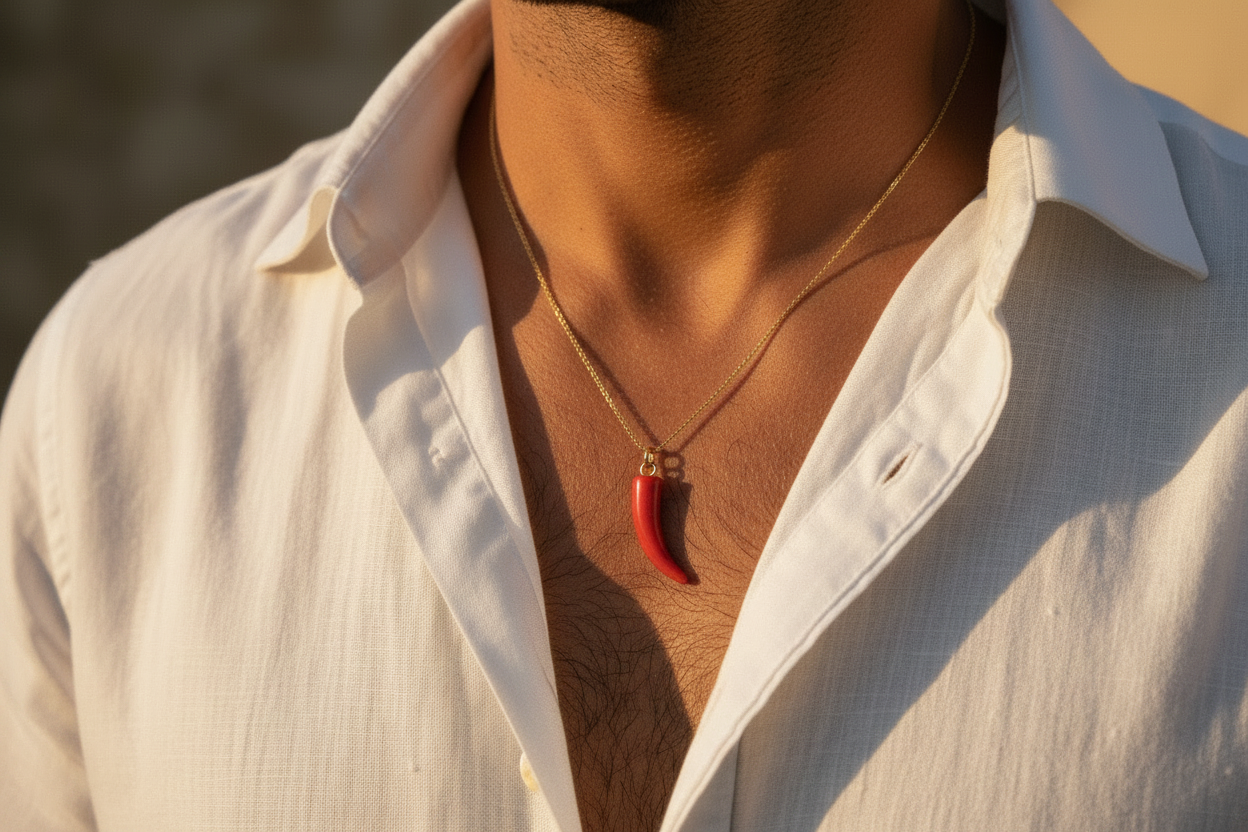
The shape itself is part of that power. Elongated and tapered to a point, following the natural curve of an animal horn, the corno is designed to direct bad energy away from the body — sharp end down, deflecting what rises up toward you. Usually red or solid gold, ideally given as a gift rather than purchased for yourself. Red because it represents vitality and strength. Given as a gift because a horn received carries more protective power than one bought for yourself.
Older Than Italy Itself

What makes the corno so fascinating culturally is how ancient it actually is. The symbol predates the Roman Empire, with roots in Neolithic and Bronze Age cultures across the Mediterranean. Long before organized religion, ancient peoples associated the horn with strength, fertility, and divine protection — horns were worn by warriors, depicted on gods, and used as offerings at sacred sites.
When Christianity spread through Southern Italy and Sicily, the Church tried repeatedly to discourage these older folk beliefs. It didn't work. Sicilians are nothing if not stubborn about the things that matter to them. The corno survived, adapted, and eventually became so woven into everyday life that it stopped being seen as a pagan symbol at all. It was simply Sicilian. Simply Italian. Simply what you do.
Today it sits comfortably alongside crucifixes and rosaries in Italian homes — because in Southern Italian culture, faith and folk tradition were never really in conflict. They coexisted, each covering what the other didn't.
The Rules Nobody Wrote Down but Everyone Knows

Like most things in Sicilian culture, the corno comes with unspoken rules that every Italian family somehow knows without being taught.
It should be red. Red is the most protective color, tied to blood, life, and power. Gold and silver horns are beautiful and widely worn, but the old belief says red is strongest.
It should be given, not bought for yourself. Receiving the horn as a gift activates its protective power. Buying it yourself is allowed — the world is practical — but a gifted horn carries more weight.
It should point downward when worn. The tip down, away from the body, directs negative energy away from the wearer to be absorbed and transmuted by the earth.
And if it breaks? That's actually good news. A broken corno means it did its job — it absorbed something that was meant for you. You thank it and replace it.
But Wait — There's Another Meaning
Here's where it gets very Sicilian.
Call a man cornuto in Sicily and you might not be talking about good luck charms at all. The word carries a second meaning that every Sicilian knows and nobody outside the culture fully gets — it's the age-old term for a man whose wife has been, shall we say, keeping busy without him. The "horned one." A man who doesn't know what's happening in his own house.
It's also used for a troublemaker. Someone who stirs things up, causes chaos, and probably knows exactly what he's doing. In Sicily, being called cornuto in the right tone of voice, with the right look on someone's face, communicates an entire story in one word.
It's sharp. It's ancient. And in Sicily, it gets deployed with spectacular timing.
But here's the thing about Sicilians — they have always had the ability to take the words that sting and turn them into something worn with swagger. Calling yourself cornuto — putting it on a hat, a mug, an apron — is a very specific kind of Sicilian humor. It says: I know what this word means, I know you know what it means, and I'm wearing it anyway because I find the whole thing funny and I refuse to take myself too seriously.
That's not just humor. That's a cultural attitude that goes back centuries — the ability to absorb what life throws at you, laugh at it loudly, and wear it like a badge. It's the same spirit that turned centuries of invasion and hardship into an unbreakable identity. Sicilians don't wilt under pressure. They make a hat out of it.
How the Corno Lives in Everyday Italian Life

Here's what separates the corno from other cultural symbols: it doesn't stay in a display case. It lives in the kitchen, in the car, on the body, at the table. It shows up on aprons and mugs and hats because Italian and Sicilian people carry their identity into every corner of daily life — and because the dual meaning of cornuto makes every single one of those pieces funnier if you know what you're looking at.
The Cornuto Red Horn Apron brings that energy straight into the kitchen where Sicilian tradition is most alive. Bold, recognizable, and deeply on-brand for anyone who cooks with one eye on the stove and one eye on who might be watching with a little too much envy. 👉 Shop the Cornuto Red Horn Apron
The Cornuto Horn Mug turns the morning coffee ritual into a small daily act of heritage — and a quiet inside joke for anyone who gets it. Personalized, funny, and unmistakably Sicilian. 👉 Shop the Cornuto Horn Mug

Wear It With Pride
The corno as wearable heritage is nothing new — Italians and Sicilians have been wearing the horn in some form for millennia. Today that looks like embroidered hats that announce exactly where you stand — on the subject of bad energy, on the subject of troublemakers, and on the subject of anyone in your life who deserves a knowing look.
The Cornuto Embroidered Hat is bold, clean, and says everything it needs to say without a word of explanation — at least not to anyone who gets it. 👉 Shop the Cornuto Embroidered Hat

And for something more personal, the Personalized Cornuto Hat lets you make it your own — because in Sicily, the best jokes always have a name attached. 👉 Shop the Personalized Cornuto Hat

A Symbol That Belongs to You
The corno has survived ancient civilizations, the Roman Empire, centuries of Church disapproval, immigration, assimilation, and the full force of modern life. It is still here. Still on doorways and dashboards and kitchen walls. Still given as gifts to new babies, new homes, and new couples. Still used to describe that one guy in every family who causes trouble and somehow gets away with it every single time.
Because some things don't need to be explained or defended or modernized. They just need to be passed down.
If you grew up Italian or Sicilian, you already know what the horn means. Both meanings. And if you're raising the next generation, make sure they know too — ideally with a red one hanging somewhere they'll see it every day and a hat nearby for whoever in the family has earned the title.
Browse all corno pieces and more in the Gifts Only Sicilians Understand collection — because some things really do require the context.

Written by Leandra Andrews