What Is the Carretto Siciliano? The Painted Cart That Carries a Nation's Soul

Some traditions don't just survive history — they burn through it, blazing with color and defiance, refusing to be forgotten.
The Carretto Siciliano — the traditional painted wooden cart of Sicily — is one of the most breathtaking expressions of folk art the world has ever produced. To outsiders, it looks like a beautifully decorated horse-drawn wagon. To Sicilians, it is something far more profound: a moving canvas that carried a community's identity, their faith, their legends, and their pride through the dusty roads of an island unlike any other on earth.
The colors alone stop you cold. Deep crimson, burning gold, cobalt blue — every surface alive with knights, saints, and stories told in pigment with the same passion a poet chooses words. This was not decoration for decoration's sake. This was a civilization saying: we are here, we are beautiful, and we will not be ignored.
If you have Sicilian roots, this tradition is part of you — whether you've ever set foot on the island or not.
A Cart Born from Necessity, Transformed by Love
The carretto siciliano emerged in the mid-1800s as a working vehicle. Farmers, merchants, and tradespeople across Sicily used these horse-drawn carts to transport goods — citrus fruit, grain, goods to market. They were the trucks of their time, essential tools of daily survival.
But Sicilians, being Sicilians, could not leave well enough alone.
What began as a simple wooden cart became one of the most elaborate folk art traditions in the world. Craftsmen — a team of carpenters, blacksmiths, carvers, and painters working in concert — transformed every surface of the cart into a masterpiece. The side panels, the axles, the spokes of the wheel, even the undercarriage hidden from view — all of it was painted, carved, and gilded with the same obsessive care.
Because in Sicily, how you presented yourself to the world was everything. Your cart was your community's face.
The Wheel: Sacred Geometry on Dusty Roads
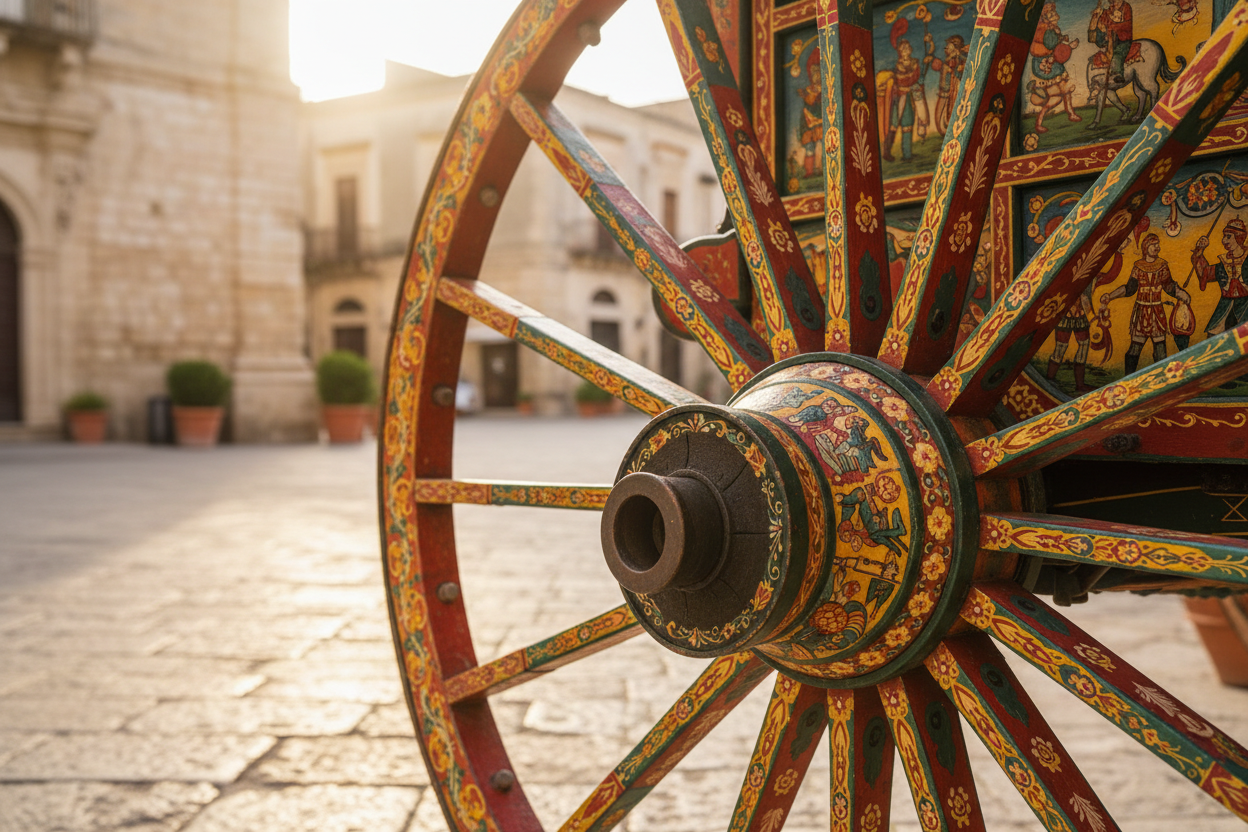
Nothing captures the spirit of the carretto quite like its wheel. Enormous, intricately spoked, and painted in blazing reds, yellows, and blues, the carretto wheel is a masterpiece of folk engineering and sacred art rolled into one.
The geometric patterns radiating from the hub were not random decoration. They carried echoes of Arab geometric art, Norman heraldry, and ancient Greek symmetry — a reminder that Sicily had absorbed the greatest civilizations the Mediterranean ever produced and made something entirely its own.
Today, the beauty of that wheel lives on in pieces like the Sicilian Carretto Wheel Ceramic Tile and the Carretto Siciliano Wheel Trivet — objects that bring that centuries-old artistry into your kitchen and home, where it belongs.

The Stories Painted on Every Panel
The scenes decorating a carretto siciliano were not chosen at random. They told stories — epic, dramatic, deeply Sicilian stories.
The most beloved came from the Opera dei Pupi, Sicily's traditional puppet theater: the legendary paladins of Charlemagne, the heroic knight Roland (Orlando), fierce battles between Christians and Saracens drawn from the medieval epic Orlando Furioso. These were the stories Sicilian families grew up hearing, performed in village squares by puppet masters who made grown men weep.
Alongside the knights rode images of patron saints — Sant'Agata of Catania, Santa Rosalia of Palermo — protectors called upon to keep the family and their livelihood safe on the road. Norman kings, Arab geometric borders, Christian iconography, and ancient Greek motifs all appeared side by side, just as they had appeared side by side in Sicilian history for a thousand years.
Every panel was a chapter. Every wheel, a verse. The man who drove that cart through the market wasn't just hauling oranges. He was carrying civilization.
Palermo vs. Catania: Even the Carts Took Sides
Ask any Sicilian and they'll tell you — everything in Sicily eventually comes down to the Palermo versus Catania divide, and the carretto was no exception.
Carts from Palermo tended toward elaborate, densely packed compositions with rich reds and golds dominating the palette. Catanese carts favored slightly different color arrangements and compositional styles. The differences were subtle to outsiders, but to a Sicilian, they were as obvious as a dialect.
This regional pride — fierce, specific, deeply local — is woven into the very DNA of Sicilian culture. It is what makes Sicily impossible to reduce to a single image, and endlessly fascinating to explore.
UNESCO Recognition: The World Finally Caught Up
In 2001, UNESCO recognized the Opera dei Pupi — the puppet theater tradition so closely intertwined with carretto art — as an Intangible Cultural Heritage of Humanity. The broader tradition of the carretto siciliano has since been celebrated internationally as one of Europe's great folk art forms.
The world, in other words, finally caught up to what Sicilians already knew.
Today, working carretti are rare. The last generation of master cart painters and carvers is aging. Museums like the Museo Etnografico Pitrè in Palermo preserve the greatest surviving examples. But the art itself — the colors, the stories, the fierce beauty — refuses to disappear.
Sicily: The Island That Absorbed Every Conqueror
To understand the carretto, you have to understand Sicily itself.
No island in the Mediterranean has been ruled by more civilizations — Greeks, Romans, Arabs, Normans, Spanish, and more — and yet Sicily was never truly conquered. It absorbed every culture that arrived on its shores, took what it wanted, and wove it into something uniquely, defiantly Sicilian.
The carretto is the perfect expression of that spirit. Its geometric borders are Arab. Its heroic narratives are Norman and French. Its religious imagery is deeply Catholic. Its craftsmanship is purely Sicilian. And the whole blazing, joyful, overwhelming thing is like nothing else on earth.
This is what it means to be from Sicily. You come from people who turned a working cart into a cathedral on wheels. You come from people who painted masterpieces on objects that hauled grain.
You come from people who refused, under any circumstances, to make something ordinary.

Carry the Tradition With You
The carretto siciliano is no longer rolling through the markets of Palermo. But its spirit is very much alive — in the families who remember, in the museums that preserve, and in the art that carries it forward.
If you want to bring a piece of that tradition into your life, these are some of our favorites:
Carretto Siciliano Shirt — wear the tradition proudly, wherever you are in the world.
Carretto Siciliano Tote Bag — carry Sicily with you every single day.
Sicilian Carretto Wheel Ceramic Tile — a piece of folk art for your home, as beautiful as the original.
Carretto Siciliano Wheel Trivet — bring the art of the carretto into your kitchen.
Sicilian Heritage Throw Pillow — a touch of Sicily in every room.
Old World Map of Sicily Tile — the whole island, beautifully captured in one piece.
Old World Map of Sicily Trivet — the entire island, strikingly rendered in a single piece.
Carretto Siciliano Gift Bag — for the Sicilian in your life who deserves something that means something.
Carretto Siciliano Blue Sticker — small, but unmistakably Sicilian.

The carretto siciliano survived two centuries, a dozen conquerors, and the modern world. It will survive anything. Just like the people it came from.

Written by Leandra Andrews