Growing Up Sicilian: The Heritage Behind the Bridal Favors Actually Worth Keeping

Where I Come From
There is an old Sicilian proverb: "Cu nesci, arrinesci" — he who leaves, succeeds. I didn't grow up hearing Sicilian from a distance. I grew up speaking it. All four of my grandparents spoke Sicilian, and my mother made a deliberate choice not to teach me Italian — because if she had, I wouldn't have been able to talk to them. She chose the older language, the truer one, the one that connected me directly to Palermo and to Terrasini, the small fisherman's town on the Tyrrhenian coast just west of the city where my father's family is from.
That decision shaped everything about how I understand heritage. It wasn't preservation for its own sake — it was connection. The point was never the language. The point was the grandparents. The language was just what you needed to communicate with them.
I am second generation. I grew up between two worlds, the way most of us do — American enough to belong here, Sicilian enough to know that something is always being translated, that certain things get lost in translation. But some things survive intact. The food survives. The stubbornness survives. And the objects survive — the ceramic pieces on the windowsill, the painted tiles propped against the backsplash, the kitchen things that came from somewhere and stayed.
This is what I think about when I design pieces rooted in Italian and Sicilian heritage. Not the postcard version of Sicily — the glamorous tourist's lemon grove. The real version. The fisherman's kitchen in Terrasini. The Palermo household where the ceramics weren't decorative — they were just there, the way they had always been there.
If you are planning a bridal shower or wedding and looking for favors that carry that kind of weight — favors that guests will keep and display and one day explain to their own children — this is what I make them for.

What the Immigrants Carried
When Sicilians left for America in the late nineteenth and early twentieth centuries, they left in enormous numbers. Between 1880 and 1930, more than a million Sicilians crossed the Atlantic, the largest mass migration from a single island in modern history. They came from Palermo and Catania and Messina and from the small coastal towns like Terrasini, where fishing had sustained families for centuries but could no longer sustain them enough.
They traveled light because they had to. A suitcase, sometimes less. Photographs wrapped in cloth. A rosary. Seeds, occasionally — basil, tomatoes, things that could be coaxed into growing in foreign soil. What they could not pack, they held in memory: the recipes, the gestures, the particular way of moving through a kitchen, the understanding that a home is built from the inside out and that the objects in it are not decoration but daily testimony to who you are and where you come from.
The ceramic tradition came with them this way — not always as objects, but as knowledge. The understanding that a kitchen deserved beauty. That a tile on a wall or a painted piece on a shelf was not extravagance but dignity. That the home, however modest, should reflect the culture that shaped the people living in it.
This is why, in the Italian and Sicilian-American households I grew up knowing, there were always ceramic pieces around. Not museum pieces. Not precious things locked away. Things that were used and touched and noticed every day. A painted trivet pulled out for Sunday dinner. A tile that had always been on that particular shelf for as long as anyone could remember. Objects that had outlasted the people who first brought them home, that had become part of the architecture of the family itself.

The Palermo Tradition and the Fisherman's Kitchen
Palermo and Terrasini represent two expressions of the same Sicilian ceramic culture, and understanding both helps explain why these objects carry the meaning they do.
Palermo is a city shaped by every civilization that ever wanted Sicily — Phoenician, Greek, Roman, Arab, Norman, Spanish. The Arabs who ruled Palermo from the ninth to the eleventh centuries transformed it into one of the most sophisticated cities in the Mediterranean world, and they brought with them the ceramic techniques that would eventually become the majolica tradition: the white tin glaze, the vivid cobalt and yellow and green pigments, the bold geometric and floral patterns that still define Sicilian decorative ceramics today. When the Normans arrived in the eleventh century they didn't erase that tradition — they absorbed it, layering their own Byzantine influences over the Arab foundation, producing the extraordinary mosaic interiors of the Cappella Palatina and the churches of the old city.
What came down from those centuries of layered influence was a ceramic culture that understood beauty as a civic and domestic value simultaneously. The same visual language that appeared on palace walls appeared in ordinary homes. The same bold colors, the same confident patterns, scaled down to the tiles of a kitchen or the painted piece on a windowsill.
Terrasini tells a different version of the same story. It is a working town — a fishermen's place — where the ceramic tradition expressed itself more humbly but no less intentionally. In the fishing households of the Palermo coast, a beautifully painted tile or a decorated kitchen piece was not a luxury. It was a statement of identity. A way of saying: we may work hard and live simply, but we come from a culture that values beauty, and we bring that culture into our home.
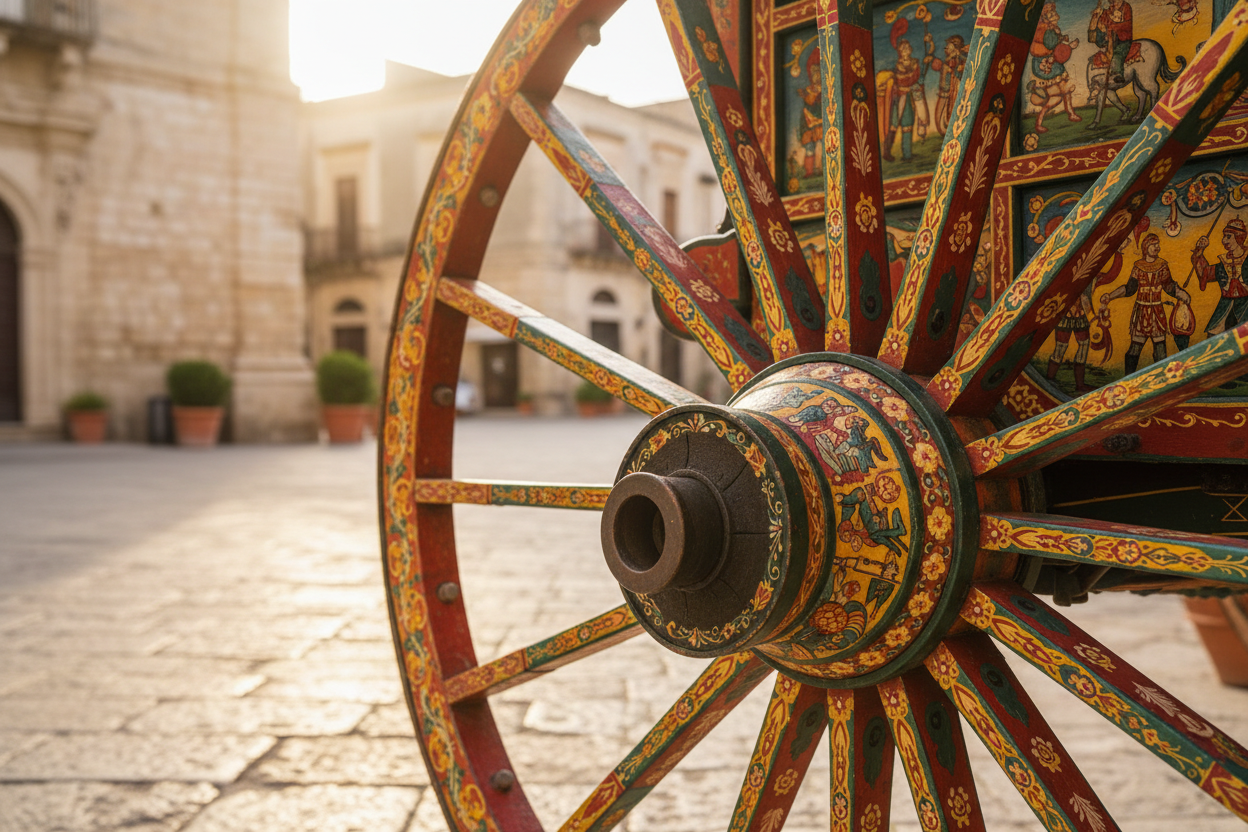
The lemon motif that runs through so much Sicilian ceramic work belongs to both worlds. Lemons have grown in Sicily since the ninth century, when Arab agricultural engineers transformed the island's interior with sophisticated irrigation systems and introduced citrus cultivation on a large scale. The lemon became Sicilian the way the olive and the vine are Sicilian — not native, but so deeply rooted over so many centuries that it is now inseparable from the identity of the place. It appears on the majolica of Caltagirone, on the painted carts of the countryside, on the ceramic facades of houses from Palermo to Syracuse. It is the visual shorthand for Sicilian abundance, for Mediterranean light, for the particular quality of life that Sicilians carry with them wherever they go.

The Trivets: A Kitchen Piece with Centuries Behind It
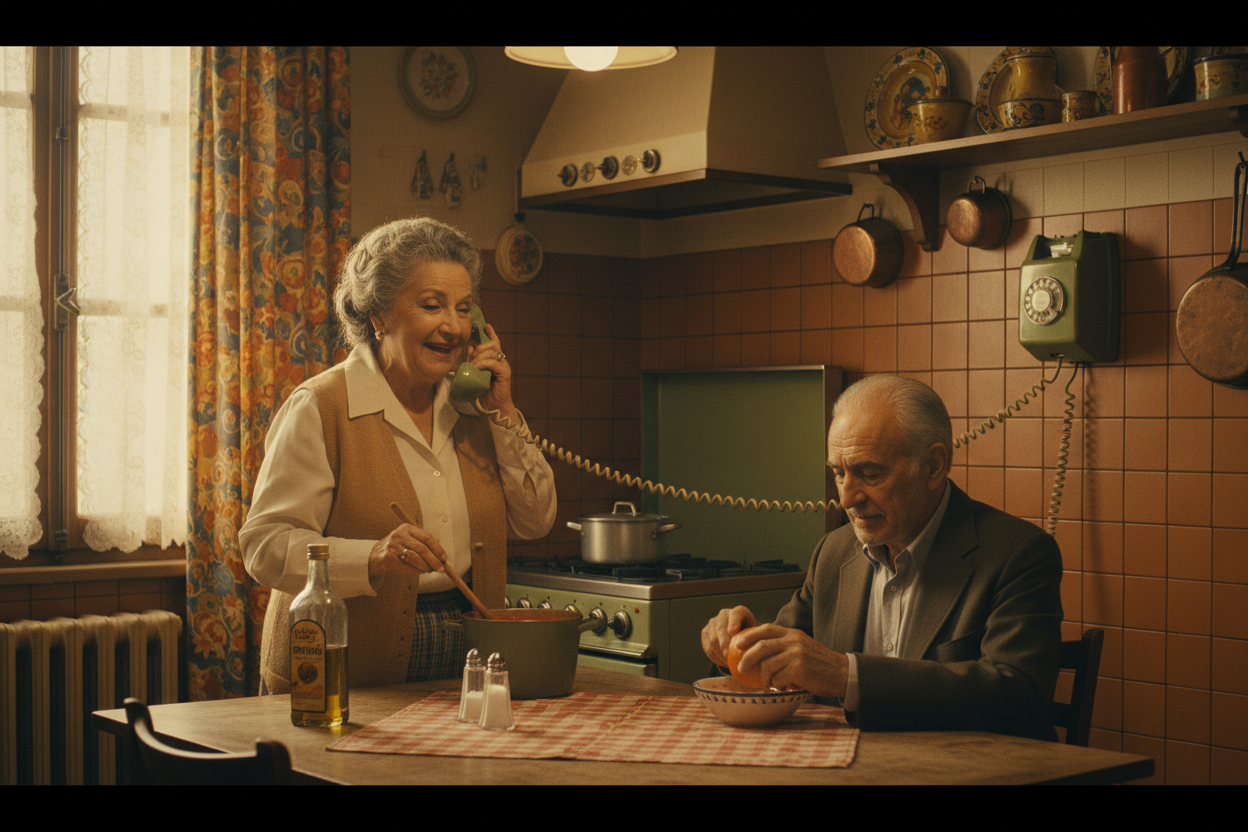
The kitchen trivet is one of the most honest objects in this tradition. It is not decorative in the precious sense — it is used, every time the pot comes off the stove, every time the dish comes out of the oven. In the Italian and Sicilian-American households I grew up knowing, the kitchen was sacred ground, and the objects in it were chosen accordingly.
The Italian Lemon Trivet carries that lemon motif in its most direct form — bright Sicilian citrus against a classic ceramic ground, the image that has decorated southern Italian kitchens for centuries.
The Rustic Italian Lemon Trivet gives that motif a weathered, heirloom quality — the feeling of something that came from a kitchen that had been in a family for generations. That quality matters in a gift. A thing that already looks like it has a history invites you to add to that history.
The Italian Lemons with Blue Toile Trivet draws on the cobalt and cream palette of Vietri sul Mare and the Amalfi Coast — one of the most enduring visual signatures in all of Italian craft.
The Terrasini Fishing Boats Trivet iInfuses your home with the sunlit beauty of Terrasini, Sicily through this vibrant ceramic trivet artwork. Rendered in a richly expressive style, the scene showcases colorful fishing boats resting along the water's edge, set beneath rugged coastal cliffs dotted with historic seaside buildings.
The Mediterranean Pottery Style Trivet speaks in the direct visual language of Sicilian majolica — the bold outlines, the vivid cobalt blues and sun yellows, the geometric and floral patterns you see in the workshops of Caltagirone and Santo Stefano di Camastra.
And the Old World Map of Sicily Trivet — the shape of the island rendered in the antique cartographic style — is a piece of geography and memory. The shape of the place that shaped so many of our families.
The Personalized Lemon Trivet carries a name, a date, a phrase — a small customization that makes a beautiful piece into a genuine keepsake.
The Che Si Dice Italian Flag Trivet is for the couple with a sense of humor who wears their heritage openly. What's Up? It is a greeting and a declaration at once.
Shop All Italian & Sicilian Trivets and Tiles →
The Tiles: Carrying the Tradition Forward
The tile is the oldest and most persistent form of Sicilian decorative ceramic. It predates the majolica tradition, predates the Norman palaces, goes back to the earliest Mediterranean cultures that understood that a fired clay surface could hold an image indefinitely — that beauty pressed into ceramic would outlast almost everything else.
Caltagirone, the hilltop city in central Sicily, has been producing hand-painted tiles since the seventeenth century. Its Scalinata di Santa Maria del Monte — a staircase of 142 steps, each riser tiled in a different pattern — is one of the most visited sites in Sicily, and it is recognized by UNESCO as a craft of genuine cultural significance. Santo Stefano di Camastra, on the northern coast, has been known for its ceramics since the eighteenth century; its main street is still lined with workshops producing the bold, graphic pieces that have made it famous. These are not craft traditions that are being preserved. They are craft traditions that are still alive.
When Sicilian immigrants came to America, they could not bring Caltagirone with them. But they could bring the impulse that produced Caltagirone — the understanding that a home deserves beauty, that a surface worth living with is worth decorating, that the objects you choose for your kitchen and your walls say something about who you are.
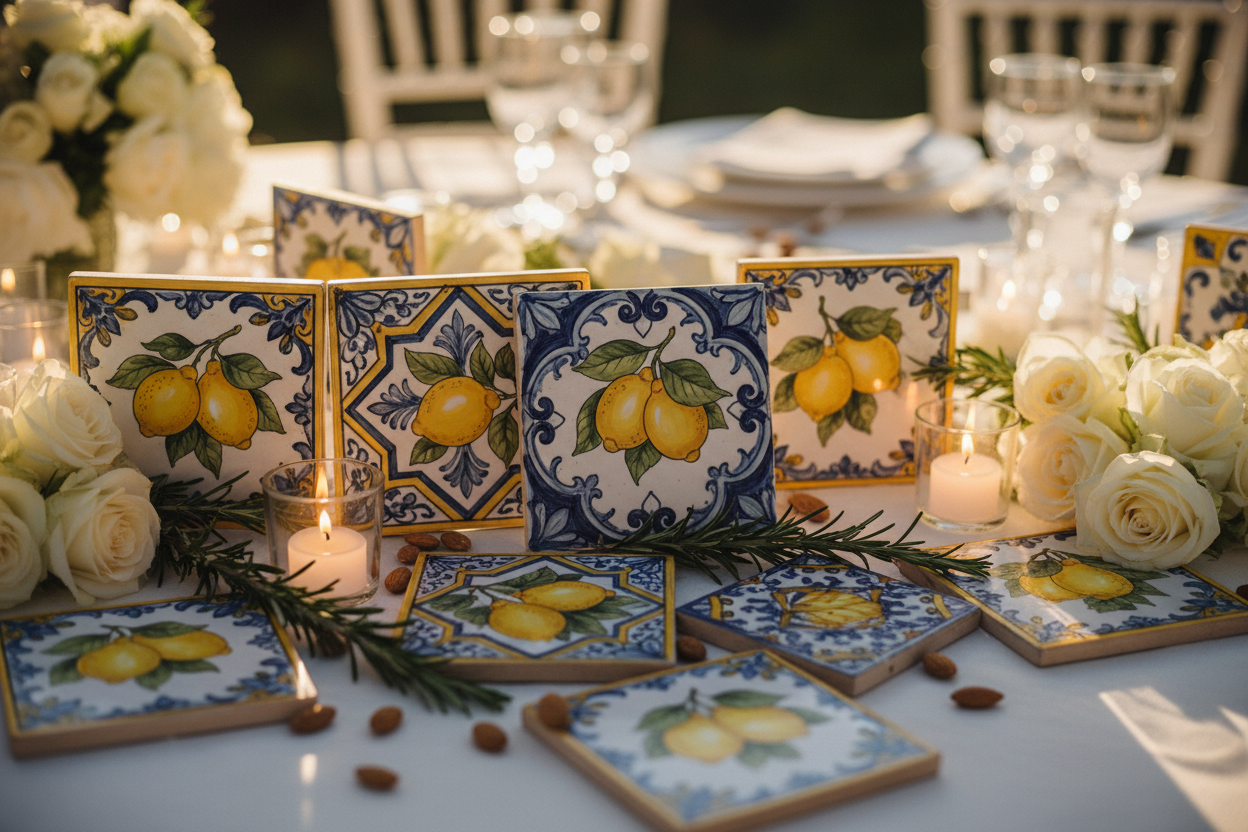
The Italian Lemons & Blue Toile Tile is the piece I see resonate most deeply at bridal showers, and I think I understand why. Lush Sicilian lemons and deep green foliage against a navy toile-style filigree border — it brings together the lemon motif of the Sicilian countryside and the refined decorative tradition of the Mediterranean villa in a single image. Available in two sizes, a 6" x 6" and a 4.25" x 4.25", it works anywhere — propped on a windowsill, hung on a wall, set into a properly sealed backsplash. It is the kind of piece a new bride puts somewhere in her first home and never moves.
The Rustic Vintage Italian Lemons Tile belongs to the more intimate end of the tradition — the domestic tiles of the fishermen's houses, the farmhouse kitchens, the stairwell landings where a single beautiful tile was placed among plain ones as a quiet gesture toward beauty in an otherwise working life. I think of my father's Terrasini when I look at this one.
The Lemons Tile with Classic Blue Border carries the clean, confident geometry of the Caltagirone tradition — the blue border framing the lemon motif the way the ceramic workshops of central Sicily have been framing their designs for centuries.
The Botanical Lemons & Blossoms Navy Tile takes the lemon motif into something richer and more dramatic — deep navy, lush botanical detail, the feeling of a fine art print pressed into ceramic.
The Mediterranean Pottery Style Tile speaks directly in the visual language of Sicilian majolica — bold, graphic, unmistakable. Paired with its matching trivet, it makes a coordinated set that tells a single coherent story.
And the Old World Map of Sicily Tile is, for Sicilian families especially, something more than a decorative object. It is the shape of where we come from. The island that shaped our grandparents, that sent them across an ocean, that they carried in memory for the rest of their lives. Rendered in antique cartographic style and meant to hang on a wall, it is a declaration as much as it is a tile.
The Terrasini Coastal Tile brings the sun-drenched beauty of Terrasini, Sicily into your home with this vibrant ceramic tile artwork. Painted in a rich, expressive style, the scene features colorful fishing boats along the water beneath dramatic coastal cliffs lined with old seaside buildings, all set against a brilliant blue sky. An artist's signature is subtly integrated into the design, adding a distinctive, collectible touch.
Browse the full tile collection →
What We Pass Forward
My grandparents left Sicily with almost nothing. They built lives here — American lives, full and complicated and shaped by two cultures at once. But the Sicilian part never left. It lived in the kitchen, in the food, in the particular way the home was kept and the table was set and the objects around the house were chosen.
A wedding favor rooted in that tradition is not a small thing. It is a continuation — of the ceramic culture of Palermo and Terrasini, of the immigrant impulse to carry beauty across oceans, of the understanding that the objects we bring into our homes say something true about who we are and what we value.
That is what I make these pieces for. Not as souvenirs. As inheritance.
Shop All Italian & Sicilian Trivets and Tiles →

Written by Leandra Andrews