What a Broomstick, Some Old Rags, and a Very Loud Nonna Taught Me About Sicilian Love
A love letter to the art of Sicilian floor mopping, sacred beds, and the grandmother who had rules for everything.

There is a specific sound that only children raised in a Sicilian household will recognize. It is not quite a crash, not quite a knock, but something in between — rhythmic, insistent, and accompanied by muttering. If you know it, your whole body just tensed up. That sound is the vastuni — a broom handle stripped of its broom — tapping, scraping, and occasionally banging against your metal bed frame at 8 a.m. on a summer morning when sleeping in was one of the great joys of being out of school and you were determined to make the most of every last minute of it.
Let me explain.
In Sicily, floor cleaning is not a chore. It is a practice. A philosophy. A moral stance. And the tools of this practice have names. The broom handle — once separated from its bristled head — becomes the vastuni. The old rags, clean but worn, cut from old worn bath towels or the kind of thick sturdy rags that still had plenty of work left in them, are the cannavazzi (where the word comes from, no one is entirely sure — but every Sicilian nonna knew exactly what they were). Together, the vastuni and the cannavazzi formed one of the most effective, most economical, and most vigorous floor-cleaning systems ever devised by Mediterranean ingenuity.
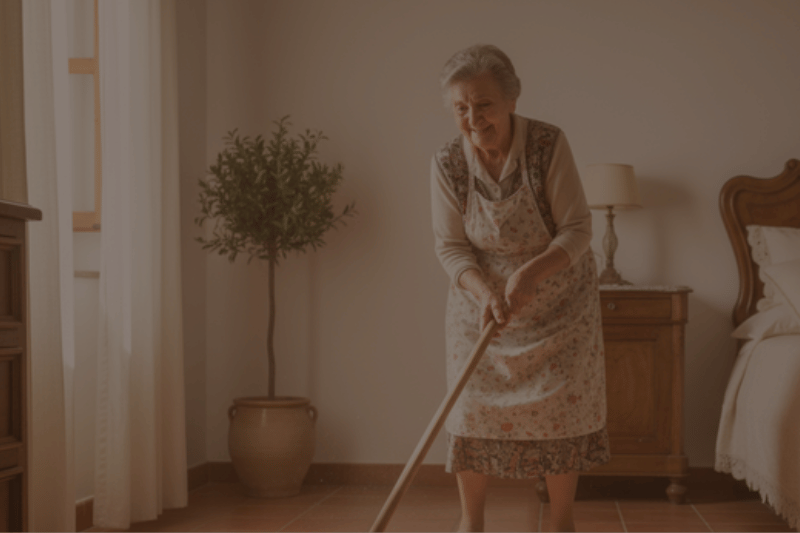
The technique was simple and brilliant: no mop bucket with a wringer, no disposable Swiffer pads, no special cleaning solution in a spray bottle. Just hot water, strong hands, and rags that still had plenty of work left in them. Nonna would wet two or three cannavazzi in hot water, wring them out with the authority of a woman who had never once left a job half-done, fold them into a working rectangle, slap them on the floor — and begin. She pushed the cannavazzi across the travertine with the vastuni, covering the kitchen, the bathroom, the hallway — every room got its due. When the rags darkened with dust and grime, they were tossed aside for a laundry load dedicated exclusively to rags — bleach included, always. Bleach was my grandmother's most trusted companion. If something could be bleached, it would be bleached. The cannavazzi came out of that wash as clean as old rags could possibly be, and ready to go again. Then she reached for clean ones and started again. And if the windows were closed and the floor was slow to dry, the whole sequence was repeated with dry rags to finish the job. No wet floor left behind. Perfetto.
Shop the Gifts Only Sicilians Understand →
Our house in San Pedro was tiled throughout in travertine — cool underfoot in summer, solid and permanent, the way Sicilian homes are supposed to be built. In Sicily, you build with stone because stone endures. You do not build for now. You build for your children and your children's children. That philosophy does not stop at the walls. It extends to every surface, every threshold, every floor — and to the woman who made sure it all stayed worthy of the family that walked on it. To my grandmother, that travertine was an honor and a responsibility. It would be kept immaculate. Always.
Now. The summer I was twelve.

My grandparents had come from Italy to stay with us — as they did, for a year at a time, the way Sicilian grandparents do when they love you enough to reorganize your entire household and remind you daily what clean really means. It was summer vacation. I was sleeping in. I was a twelve-year-old girl in the middle of a golden, obligation-free morning, face-down in a pillow, not a thought in my head.
And then: thwack. thwack. scrape. thwack.
She came into my bedroom with her vastuni and her wet cannavazzi and she began. My grandmother was a small woman — not quite five feet tall — but she had a presence that filled every room she walked into, and she moved through that bedroom like someone twice her size. Fast. Efficient. With the focused urgency of someone who had floors to do and was not going to let a sleeping grandchild slow down the operation. The broomstick knocked against the leg of my metal bed frame. It scraped the baseboard. It rattled against the wall. She moved it back and forth with the energy of a woman who had been awake since sunrise and could not understand why anyone would still be horizontal.
And the whole time, in that voice that pretends to be a whisper but isn't really fooling anyone — she said it:
"Un ti prioccupari. Io nun fazzu scrusciu. Tu dormi."
"Don't worry. I'm not making any noise. You sleep". — all while making a tremendous amount of noise.
I was twelve. I did not have the words for what I was feeling. But I knew it was not gratitude.
What I did not understand then — what takes years and distance and your own tired adulthood to understand — is that she was telling the truth. In her mind, she was not making noise. She was cleaning. Those are categorically different things. Noise is a disturbance. Cleaning is love. The banging of the vastuni against the bed frame was not noise. It was care. It was her way of saying: this house matters, this floor matters, you matter — and I will prove it at 8 a.m. whether you are conscious or not.
Shop the Gifts Only Sicilians Understand →
The Bed Had Rules. Three Was Not One of Them.

Having finished with the floor, my grandmother turned her attention to the bed itself. And here, the rules multiplied.
Fresh sheets were a serious event. I can still see this tiny, unstoppable woman and my mother on opposite sides of the mattress, snapping a fitted sheet out of the dryer with the coordinated precision of a two-woman operation that had been running for decades. Warm cotton billowing up, hands moving fast, corners tucked with an authority that left no wrinkles and no room for argument.
One morning I made the mistake of trying to help. I grabbed a corner of the fitted sheet, proud of myself, ready to contribute. My grandmother nearly had a heart attack.
She froze. She looked at the sheet. She looked at me. She looked at my mother. And then came the finger — that single wagging index finger that meant the discussion was already over — and a scolding that made very clear I was to step away from the sheet immediately and not touch it again.
Three people making a bed, she explained, is bad luck.
This is a real Sicilian folk belief — one of those superstitions so old that no one remembers exactly where it came from, only that it is true and that you do not tempt fate over something as easily avoided as a bed sheet. Whatever the origin, the rule was absolute. One person could make a bed. Two people could make a bed. Three people making a bed was simply not done.
I was not invited back to help with the sheets for the remainder of that visit.
You Do Not Sit on the Bed

There was a second rule, equally firm, that governed the bedroom in a Sicilian household: the bed is for sleeping. Only sleeping. That's it.
You did not sit on the edge of the bed to put your shoes on. You did not lie on top of the covers in the afternoon to read or watch television. You did not perch on the corner of the mattress to have a conversation. The bed was made in the morning and it stayed made until the evening, when it was turned down for its singular and sacred purpose.
We used to watch the Brady Bunch and see the kids sprawled across their beds doing homework on their stomachs and think it looked like the greatest thing in the world. My cousins and I actually tried it once. That did not go over well with Nonna. We did not try it again.
To a Sicilian nonna, a person lounging on a made bed in the middle of the day was the domestic equivalent of wearing a tuxedo to dig a ditch. Everything has its purpose. Everything has its time. The bed is for sleeping. The chair is for sitting. These distinctions matter.
There was practicality behind it too — in a Sicilian household, a made bed represented order, dignity, and a home that was ready to receive guests at any moment. You never knew who might come to the door. The house was always to be presentable. A rumpled bed, even behind a closed door, was a disorder that a proper Sicilian woman simply would not allow.
And Whatever You Do, Do Not Put Shoes on the Bed

Of all the bedroom laws, this one carried the most weight. No shoes on the bed. Not new shoes from the store, still in the box. Not your own shoes that had just come off your feet. Not any shoes, under any circumstances, ever.
In Sicilian and broader Southern Italian tradition, shoes on the bed carry a powerful and deeply unwelcome meaning. It is one of those beliefs so old and so ingrained that it needs no explanation — you simply do not do it. The rule arrived with my grandmother from a village in Sicily, crossed an ocean, and took up permanent residence in a house in San Pedro, California, where it was enforced with exactly the same seriousness as it had always been.
My grandmother did not explain all of this in so many words. She did not need to. The look was enough. Shoes near the bed produced a reaction so swift and so absolute that you understood immediately and permanently that this was not a suggestion. It was a law older than anyone in the room.
You put your shoes on the floor. Where they belong.
The love that doesn't come quietly.
That is the thing about Sicilian heritage that is almost impossible to explain to anyone who didn't grow up inside it. The love is not soft. It is not quiet. It arrives with hot food you didn't ask for and clean floors you slept through and a tiny grandmother under five feet tall who somehow managed to be the biggest presence in every room she entered — and who knew the exact number of people permitted to make a bed and would not negotiate on this point.
If you were raised in a house like this, you don't just remember it. You carry it. It's in your bones the way stone is in a Sicilian hillside — permanent, structural, part of the foundation. You find yourself making the bed the same way. You feel a flicker of something when someone sits on a freshly made bedspread. You do not put shoes on the bed. You just don't.
And if someone in your life gets it — if they grew up hearing the same language, learning the same rules, sleeping through the same kind of cleaning — then you don't need to explain any of it. You just look at each other and laugh.
That's what we're here for.
Gifts Only Sicilians Understand
If any of this made you smile, nod, or think of someone you love — we have gifts for that. Gifts that don't need explaining. Gifts that say I see you, I know where you come from, and I get it.
Shop the Gifts Only Sicilians Understand at ItalianSicilianGifts.com

Written by Leandra Andrews